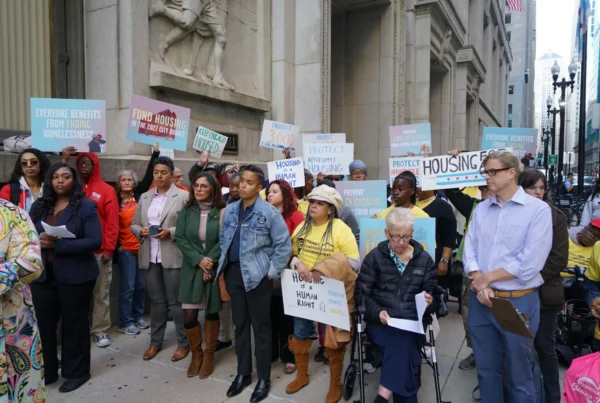

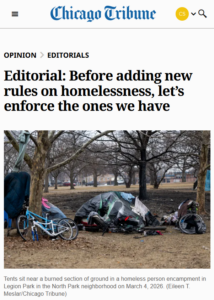
 On April 15, the Chicago Tribune Editorial Board published an editorial opposing the passage of HB 1429, state legislation that would prevent local governments in Illinois from fining or arresting people experiencing homelessness for life-sustaining activities like sleeping or eating on public property. The editorial’s misguided arguments against the bill prioritize addressing the discomfort that housed neighbors feel seeing people with no other options seek shelter in public spaces, with complete disregard for real, sustainable solutions.
The Editorial Board acknowledges, “Homelessness is punishing in itself without the fear of being fined or arrested simply for surviving outdoors.”
Punishing people for experiencing homelessness doesn’t change the fact that they have nowhere else to go. Chicago’s emergency shelters are frequently at capacity, and even when they are not, there are many reasons why the available options may not align with the needs of people living in encampments. Many congregate shelters are gendered, requiring separation of families or couples who rely on each other for survival. Shelter hours may not align with existing employment; they may not be able to accommodate beloved pets; or the shelter may be far from community and connections that have been established nearby, among other concerns. The Editorial Board acknowledges the need for “adequate shelter and services,” but fails to name the real solution to homelessness—safe, stable housing. We cannot punish people out of frustration over the fact that we have failed to provide adequate solutions.
Counter-productive responses like fines and arrests only further isolate and marginalize people experiencing homelessness, creating additional barriers when attempting to secure housing or employment. Having a ticket or arrest on your record can dissuade a landlord from providing a lease or an employer from offering a job.
More than forty municipalities across the state have these “anti-camping” ordinances in place, the second highest total in the nation behind only California. Chicago Coalition to End Homelessness looked into the impacts of these ordinances and found that frequently people are ticketed repeatedly without any change to their housing status. Additionally, when ticketed or summoned to court, people experiencing homelessness often lack the resources to appear or pay the ticket.
While the Editorial Board argues that this bill “prioritizes the rights of unsheltered individuals without equally addressing the effects on other people who use public spaces,” we would argue the Board is willfully ignoring the root causes of homelessness and the fact that HB 1429 does not hinder cities’ ability to address legitimate health and safety concerns. We encourage the board to seek answers from service providers, advocates, and people with lived experience who truly understand what sustainable solutions look like and work with us to advocate for those solutions.
Until we have enough housing that is accessible for everyone who needs it, people need a place to exist, be in community, and survive. Illinois needs HB 1429.
Signed by
Organizations
360 Youth Services
A Just Harvest
A Safe Haven Foundation
Abundant Housing Illinois
Access Living of Metropolitan Chicago
ACLU of Illinois
AFC-Community Development Corporation
Agape Community Outreach Mission (Kankakee)
AIDS Foundation Chicago (AFC)
All Chicago, Making Homelessness History
Alliance to End Homelessness in Suburban Cook County (Hillside)
Alternatives, Inc.
Anew: Building Beyond Violence and Abuse (Homewood)
Apartment and Housing Rentals Foundation (Decatur )
Arab American Family Services
Association for Individual Development (AID) (Aurora)
Brightpoint
Cannabis Equity IL Coalition
Carbondale Warming Center
Catholic Charities of the Archdiocese of Chicago
Catholic Charities, Diocese of Joliet
Catholic Conference of Illinois
CCPSA
Center for Housing and Health
Center for Mad Culture
CG Ink
Champaign County Health Care Consumers
CHHRGE (Chicago Health and Homelessness Response Group for Equity)
Chicago Area Fair Housing Alliance
Chicago Center for Psychoanalysis
Chicago Coalition to End Homelessness
Chicago Coalition to End Homelessness Youth Committee
Chicago Funders Together to End Homelessness
Chicago House and Social Service Agency
Chicago Therapy Collective
Chicago Women’s AIDS Project
Chicago YAB
Children’s Home Association of Illinois (Peoria)
Citizen Action/Illinois
Coalition Coordinator at Illinois Harm Reduction & Recovery Coalition
Communities United
Community Behavioral Healthcare Association (CBHA)
Connections for the Homeless
Corporation for Supportive Housing
Covenant House Illinois
Cunningham Township (Urbana)
Deborah’s Place (Chicago)
Disability Housing Justice
Dove, Inc. (Decatur)
El Rescate Transitional Living Program
Empowerment Opportunity Center
Equality Illinois
Erie Family Health Centers
EverThrive Illinois
Fortitude Community Outreach (Kankakee)
Fractal House
Golden Rainbows of Illinois South
Greater Chicago Food Depository
Health & Medicine Policy Research Group
Heartland Alliance Health
Heartland Continuum of Care (Springfield)
Helping Hands of Springfield
Hesed House (Aurora)
Home Sweet Home Ministries (Bloomington/Normal)
HOPE Fair Housing Center (Wheaton)
Housing Action Illinois
Housing Forward (Maywood)
Housing Opportunities and Maintenance for the Elderly Inc. (H.O.M.E.) (Chicago)
Housing Task Force
Illinois Collaboration on Youth
Illinois Partners for Human Service
Illinois Public Health Institute
Impact Behavioral Health Partners
Impact for Equity (Chicago)
Impact Global Inc
Inner Voice Inc (Chicago )
James B. Moran Center for Youth Advocacy
Joining Forces for Affordable Housing (Evanston)
JOLT Foundation
JOURNEY | The Road Home (Palatine)
Lake County Coalition for the Homeless
Lake County Crisis Center (Zion)
Lake County ROE (Antioch, Illinois)
Latino Policy Forum
Legal Action Chicago
Legal Council for Health Justice
Life Is Work Resource Center
LULA Peoria – NFP
LYTE Collective (Chicago)
McHenry County Mental Health Board
McLean County Center for Human Services
Mental Health Autonomy Alliance
Metropolitan Family Services (Chicago)
Metropolitan Planning Council
Michael Reese Health Trust
MISI (Brighton)
N/NW Suburban Housing Task Force
NAMI Chicago
NAMI Illinois
NAMI McHenry County (Crystal Lake)
Neighbors for Affordable Housing
New Beginnings Recovery Homes Incorporated
New Moms (Chicago and West Suburban Cook County)
Niles Township Government (Skokie)
North Cook Intermediate Service Center (Des Plaines)
Northern Illinois Homeless Coalition (Rockford as well as Boone, DeKalb and Winnebago Counties)
Northwest Alliance for Housing Affordability (Arlington Heights )
Northwest Center (Chicago)
Northwest Compass (Mount Prospect)
NWS Outreach Volunteers (Chicago)
Open Communities (Evanston)
Open Door Health Center of Illinois
Orange Tent Project
Pads of Elgin
Palenque LSNA
Peoria Proud
Phoenix Community Development Services (Peoria)
Phoenix Foundation, NFP (Chicago)
Poor People’s Campaign
PrimeCare Health
Proactive Community Services
Public Action to Deliver Shelter, Inc. DBA Hesed House
Pushing Envelopes Chicago (Chicago)
Raise The Floor Alliance
Reassemble Education & Training
Red Line Service Institute (Chicago)
Regional Office of Education
Respond Now (Chicago Heights)
SAFE Illinois (Vernon Hills)
Sana Healing Collective
Sangamon Valley Sierra Club (Springfield)
Shelter Youth and Family Services
South Suburban Housing Center
South Suburban PADS (Chicago Heights)
Spannaus Consulting
Steven’s Home (Woodstock)
Students Against Exclusionary Zoning (at UChicago) (Chicago)
Supportive Housing Providers Association (SHPA)
SWAN
Take Action Today (West Frankfort)
TASC
Teamwork Englewood
The Boulevard of Chicago
The Children’s Place Association (Chicago)
The Harbour (Park Ridge)
The Network- Advocating Against Domestic Violence
The Night Ministry (Chicago)
The Porchlight Collective SAP
The Project of the Quad Cities
The Puerto Rico Project
Thresholds
Together We Cope (Tinley Park)
Treatment Alternatives for Stronger Communities
Trilogy, Inc.
UChicago Against Displacement
UChicago Democrats Housing Policy Caucus (Chicago, IL)
UCHRP
United Way of Pekin
University of Chicago Harm Reduction Project
Veterans Path to Hope (Crystal Lake, Grayslake, Hebron, Chicago, Rockford )
Will County Continuum of Care, serving Will, Kendall, and Grundy Counties
www.holistichealingsource.org
Individuals
Erica Agudelo
Janice Antonio
Sophie Babcock
MacKenzie Bearley
Cori Blum
Joann Boblick
Niketa Brar
Dee Camp
Marissa Cerant
Victoria Chan
Hannah Chandler
Elizabeth Clawson
Nicole DelZenero
Thomas Edwards
Tamara Fouche
Audrey Gladson
Bonnie Grotjan
Dordie Hester
Johnpaul Higgins
Janet Hotch
Dan Immergluck
Tamara Jackiw
Timothy Jackson
Kirsten Jacobson
Betsy Johnston
Niya Kelly
Nafia Khan
Savannah King
Cassidy Kraimer
Patrick Lindley
Elizabeth Malik
Dion McGill
Matthew Mikkelsen
Amelia Morrison
Jane Murtaugh
Deirdre OConnor
Holly O’Hern
Loretta Pable
Sam Paler-Ponce
Renni Pollock
Steven Reaves
Saeed Rezko
Amy Roberts
Kaelyn Robinson
Elizabeth Rochford
Morgan Rosenberg
Lynda Schueler
Brooke Sinnen
Justine Sirhan
Armando Smith
Mike Stanislawski
James Stewart III
Adrienne Stricker
Sara Szwankowski
Mary Taylor
Suhana Thakrar
Amelia Thelen
Sophia Torres
Cynthia Tullio
Stefania Tullio
William Tullio
Isabel Virgen
Erin Vogel
Carson Wang
Lauren Winder
Yogi Liam
List updated 5/5/26