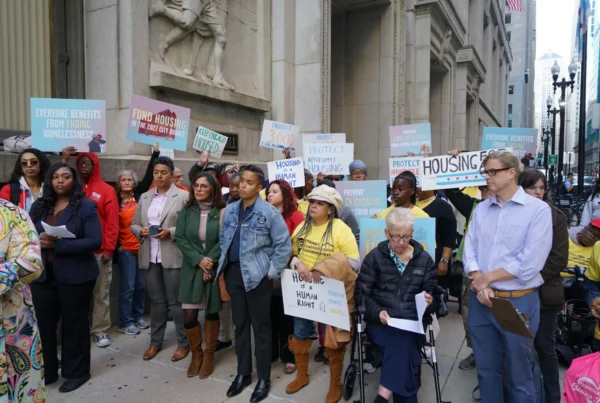

On Chicago’s northwest side, a community of unhoused people fought the city to stop the closure of their Legion Park encampment. Despite the loss, their story serves as a blueprint for resistance.
by
We know how this story ends—kind of. On March 17, dozens of city workers pulled up to Legion Park in the predawn light, their tires and boots crunching through a layer of glittering snow. They were housing workers and cops, security officers and dump truck operators, and they were there for an encampment closure, an eviction of 20 or so people from their tent homes. To do this, the workers brought offers of temporary shelter, personal protective equipment, and guns.
In January, eviction notices started appearing on trees, fences, benches, and light poles around the 51-acre, oblong park that straddles West Ridge, Lincoln Square, and North Park. At the camp’s height, two dozen tents were scattered loosely along the river channel into a two-part community. One group was clustered off of Ardmore and Jersey, a bit north of a playground, while another was nestled a hundred yards farther, behind the McDonald’s on Peterson. To the east of the park was the river; to the west were the backs of private homes.
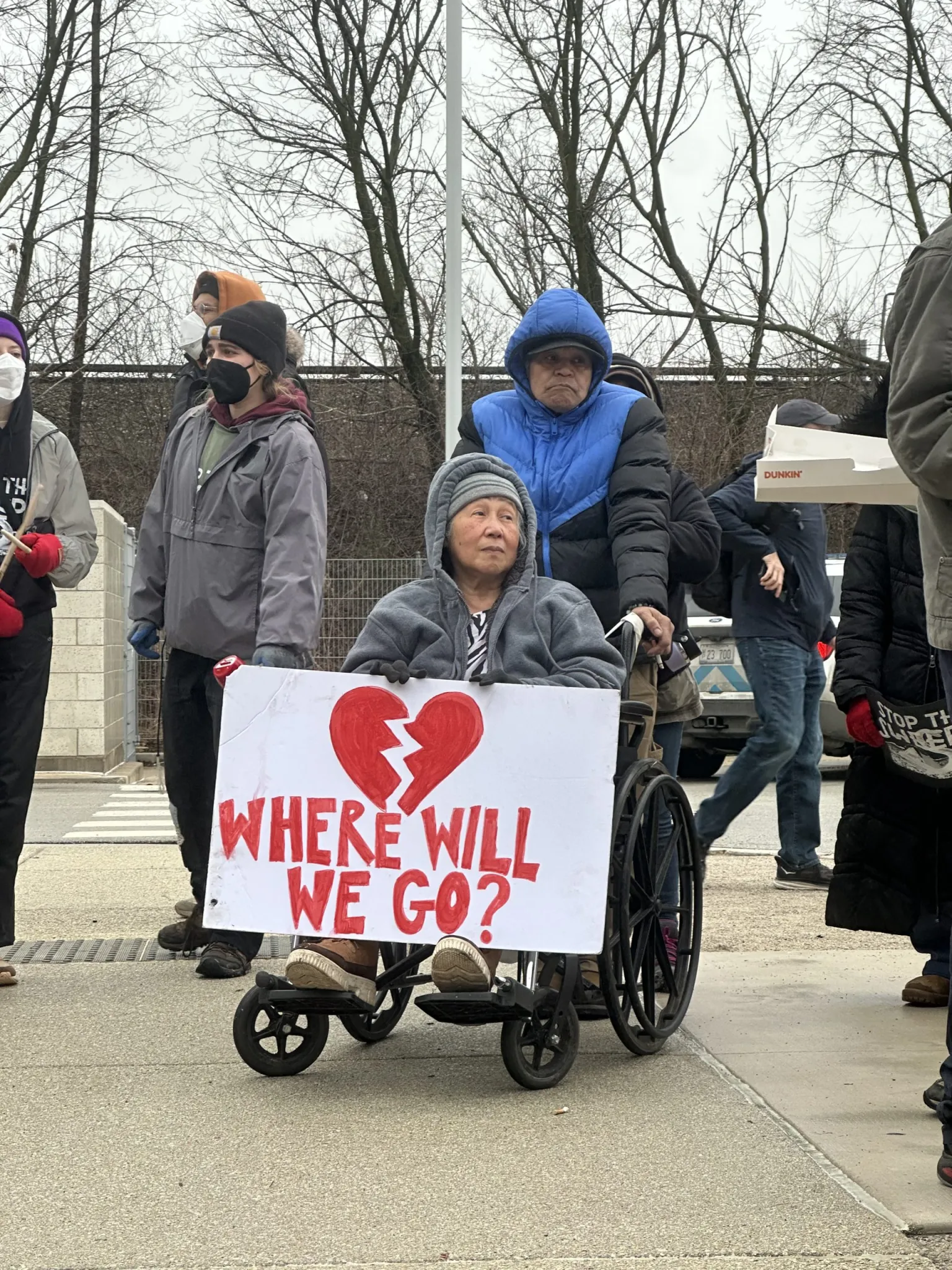
Credit: Katie Prout
From the Article:
A few weeks later, she had a new apartment offer: a one-bedroom on the north side with a dining room and a building elevator. All that she was waiting for now was the inspection. While she waited, Carmen attended a meeting with Parks for All, the Chicago Coalition to End Homelessness, and two dozen other unhoused residents—not just from Legion Park, but from public parks all over Chicago. They discussed fire safety, park surveillance cameras, and tent size. There, for the first time, Carmen saw the park district’s homelessness policies and proposals.
“They decided this without knowing what it is to be here,” she said, disgusted. “How the hell—excuse me—the people in power could make that decision when it comes to our life? It’s not their life, it’s our life.” With low wages, high rent, few jobs, and the continued terror of immigration raids, homelessness in Chicago is going to continue to rise, Carmen pointed out. Under this reality, she wondered, “Why did they spend all that money and all that energy moving people?”