
The city has promised to offer long-term housing, but some advocates are voicing doubts about the plan to move roughly 20 residents from the Legion Park tent city Tuesday.
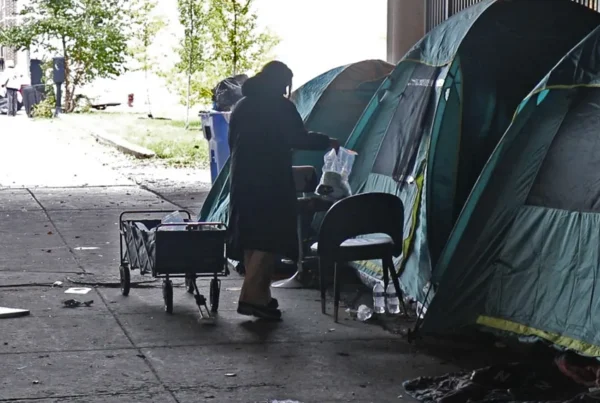
Snow and ice covered Carmen Laude’s wheelchair. A mattress, turned upright, served as the front door of her tent in Legion Park, which straddles a mile of the Chicago River on the Northwest Side.
Inside the tent, Laude, 72, cooked soup over a propane-powered stove. The pot was “big enough to feed everyone who is hungry,” she said, motioning to the rest of the encampment, which consists of 15 tents.
As Laude kept an eye on the soup Monday, a city of Chicago social worker stopped by with news that she could get an apartment for $950 a month. Laude, who has lived in the park nearly two years, told the city staffer she couldn’t afford that much on her $1,974 monthly Social Security income.
“All they do is, ‘OK, you’re moving from there to there.’ That’s not going to help — destroying all the things we accumulated for our needs,” Laude said. “That’s killing.”

Carmen Laude cleans spoons in her tent at an encampment at Legion Park on Chicago’s Northwest Side on Monday. | Anthony Vazquez/Sun-Times
From the article:
Homeless advocates say the number would be about eight times higher if it included people who “double up” with friends and relatives due to eviction or economic hardship.
President Donald Trump’s administration last year announced it was shifting federal homelessness funds away from permanent housing and into temporary shelter with work and drug-treatment requirements.
Given that shift, Chicago needs city and state officials to “step up and fill in the gap as much as they can,” said Mary Tarullo, director of city policy for the Coalition to End Homelessness.
“Instead of expending any resources on closing encampments, we need more housing and, until we have housing for everyone, we cannot be closing off public spaces to people who don’t have it,” Tarullo said. “It’s not solving the problem at all.”