
By Niya Kelly, Director of State Legislative Policy, Equity, and Transformation
Each year, staff, grassroots leaders, and partners from the Chicago Coalition to End Homelessness (CCH) advocate for statewide measures to help remove barriers for people experiencing and at risk of homelessness.
After the completion of the Illinois General Assembly’s legislative session on May 31, CCH is celebrating successful state budget advocacy by our policy, Law Project, and organizing staff, alongside our grassroots leaders. Working with organizational and legislative allies, our efforts prevented additional cuts to the Home Illinois program and secured new funding for students experiencing homelessness. Meanwhile, we also recognize the urgent need to increase state revenue to ensure funding can grow as threats to federal homelessness programs become more dire.
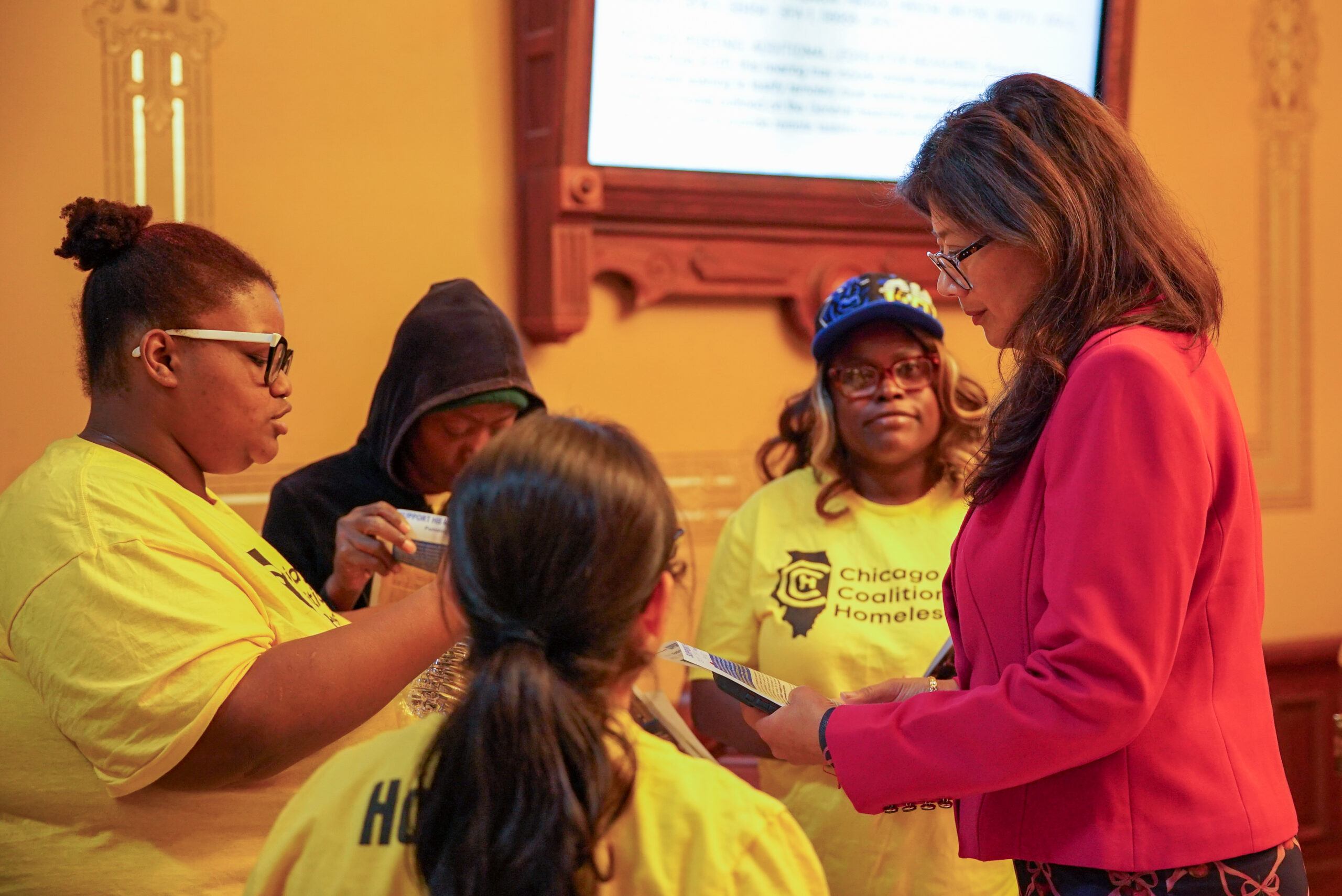
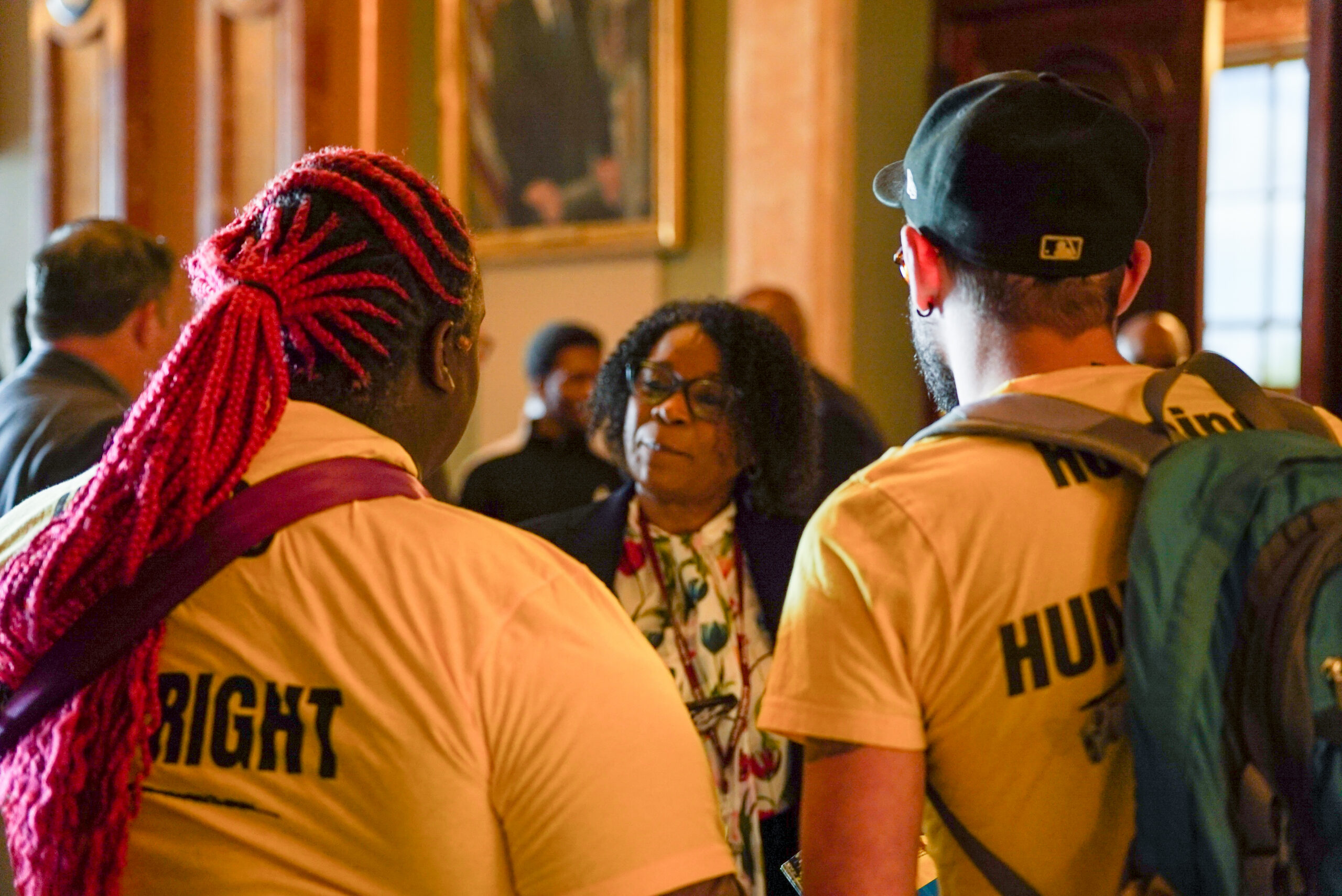
CCH hosted six lobby days this session, traveling to Springfield with grassroots leaders, youth advocates, high school students and teachers, associate board members, and the Homeless Prevention Coalition, a statewide coalition of homeless service providers and Continuum of Care (CoC) staff. These trips create opportunities for people to speak directly with their representatives, share their personal stories, and ask them to support both CCH’s substantive legislation and important funding in next fiscal year’s state budget.
In response to CCH action alerts, supporters from across the state asked legislators to move our legislative agenda forward through 785 emails and phone calls to legislators, as well as hundreds of supportive witness slips.

Here’s what we accomplished with your support:
Community Partner Fair Contracting Act (HB4340)
Sponsors: Representative Dagmara Avelar and Senator Michael W. Halpin
CCH supported the passage of legislation to improve the state’s contracting systems by increasing transparency. It will strengthen accountability in contract processing and payment timelines, reduce administrative burden, and help community-based organizations deliver essential services more sustainably.
These reforms recognize that nonprofits and community providers are critical partners in the provision of care and services across Illinois. Delayed contracts and payments have real impacts on organizations, workers, and the communities they serve. These negative impacts are particularly felt by small and women–run organizations, as well as staff and clients who are disproportionately Black or other people of color. This legislation includes provisions impacting the Grant Accountability and Transparency Act (GATA), the Prompt Payment Act, and the Court of Claims Act.
This victory comes after three years of collaboration and negotiation, with Forefront and Illinois Partners for Human Service leading the Health and Human Services and Contracting groups in this work.
State Budget
Home Illinois
CCH and our allies in Springfield successfully fought back against Gov. Pritzker’s proposed cuts to Home Illinois, the state’s comprehensive strategy to address homelessness by expanding affordable housing and strengthening the safety net. This initiative brings together residents, community organizations, and state agencies to help people experiencing homelessness achieve financial stability.
In February, the Governor proposed cutting funding to the program by $11.4 million, adding to nearly $27 million in cuts included in the current budget. These proposed cuts were restored in the final FY27 budget, keeping funding at nearly the same level as FY26. This includes funding for Homelessness Prevention, Permanent Supportive Housing, Homeless Youth and Emergency, and Transitional Housing.
Thank you to Senator Adriane Johnson and Representative Lindsey LaPointe who served as our legislative champions, as well as our organizational partners Housing Action Illinois (HAI) and Supportive Housing Providers Association (SHPA).
Funding for Students Experiencing Homelessness
Throughout this legislative session, CCH advocated for an increase to the Illinois State Board of Education’s budget designated for school districts to implement interventions to identify and assist students experiencing homelessness. The final FY27 budget included $2 million for this purpose. This funding has not been included in our state budget for more than 15 years and will allow school districts to respond to students’ immediate needs from clothing and hygiene products to housing and transportation.
Thank you to Representative Laura Faver Dias and Senator Lakesia Collins who supported this budgetary ask as our legislative champions, alongside Jimmy Pawola, the Director of McKinney-Vento Operations in Area 1, and Prince Washington and April Harris who all shared their lived experience and testified in committee.
“With the rising cost of living, we expect the number of students experiencing homelessness to rise. The newly secured funding for the state grant is a vital lifeline for our schools. We are deeply thankful to the legislature for this investment, which allows us to remove immediate barriers to enrollment and attendance. Funding homeless education isn’t just a budget line item, it is an active investment in the safety, dignity, and future of Illinois students.”
– Jimmy Pawola, Director of McKinney-Vento Operations, Area 1 Lead Liaison
FRESH program
As a result of new work requirements implemented by the Trump administration, about 120,000 Illinoisans lost their food assistance benefits (SNAP) at the beginning of May. As a member of the Save Our SNAP coalition, CCH advocated for the Families Receiving Emergency Support for Hunger (FRESH) program, a state-funded emergency assistance off-ramp. This program will provide one-time emergency support equal to three months of a household’s lost SNAP benefits, helping impacted Illinoisans weather this change. The General Assembly allocated $70 million to support this important program.
Thank you to Greater Chicago Food Depository and the Save Our SNAP coalition for your advocacy.
Revenue
The General Assembly passed a new revenue package, which includes decoupling some state taxes on businesses from new federal tax provisions, as well as taxes on digital ads, fantasy sports, tobacco, and sports betting on prediction market websites. But Illinois continues to struggle to identify and sustain progressive revenue. Each year as General Assembly members attempt to fully fund the budgetary items that are important to them and their constituencies, they are faced with difficult decisions to either make sweeping cuts or find new ways to pay for important programs and services.
Illinois will continue to face budget shortfalls and we need to explore options for a major overhaul of our tax system. Billionaires in Illinois need to pay their fair share. As the cost of living rises and federal funding disappears, funding for housing and homeless services is more necessary than ever. We’re seeing compounding threats coming from the federal government, with cuts to funding for permanent housing and short-term rental subsidies putting thousands of Illinoisans at risk of losing their housing.
Our homeless, housing, and other social service providers recognize the need to increase capacity as demand for services grows, but they are struggling just to maintain their current level of services. Meanwhile, many of their staff are also on the cusp of needing the very services they provide. We must tell our Governor and the General Assembly to take bold steps to overhaul our tax system to make billionaires pay their fair share.
Advocacy Continues
The following bills did not clear the legislative hurdles necessary this year, but we will continue our advocacy during veto session.
Community Safety Through Stable Homes Act (SB 2264)
Sponsor: Sen. Karina Villa
Municipalities throughout Illinois have enacted so-called “crime-free housing and nuisance property” ordinances (CFNOs) under the guise of fighting crime and keeping communities safer by allowing the police and landlords to evict tenants who are accused of breaking the law. However, in practice, CFNOs establish a system that forces housing providers to unfairly penalize and sometimes even evict tenants based on any alleged criminal or nuisance activity—no matter how minor—pushing families into instability and even homelessness, ultimately undermining public safety.
CFNOs frequently exclude people of color from housing and endanger our community’s most vulnerable members. This includes survivors of domestic violence and people with disabilities, whose calls for emergency services or the police have led to eviction rather than the assistance needed. These ordinances often violate fair housing and other civil rights laws.
The Community Safety Through Stable Homes Act would help protect people from unfair discrimination, keep families in their homes, and encourage more effective responses to criminal activity in local communities.
Decriminalization of Homelessness (HB 1429)
Sponsor: Representative Kevin Olickal
In response to the U.S. Supreme Court’s Grants Pass v. Johnson decision allowing local governments to criminalize homelessness, CCH is partnering with Housing Action Illinois and other advocates on legislation to prohibit municipalities from passing unjust and counterproductive ordinances directing local law enforcement to arrest or ticket individuals who are experiencing homelessness for having nowhere else to go.
Illinois ranks second in the nation after California in the number of municipalities adopting these ordinances, in some cases before homelessness has even become an issue in their community. These ordinances do not provide a solution to homelessness and only cause further harm to people experiencing homelessness and the providers who serve them. Imposing fines and arrests can have devastating consequences for individuals’ future access to employment and housing. Local governments should focus on constructive solutions to ending homelessness, rather than exacerbating the challenges that poverty and homelessness already create.