Updated April 10

CCH Law Project staff
Youth Futures, CCH’s mobile legal aid clinic for homeless youth, celebrated its 15 years at a Justice Circle reception April 9 at Revolution Brewpub in Logan Square.
Since its inception in 2004, Youth Futures has served nearly 3,000 youths. Youth Futures is part of CCH’s Law Project, the only legal aid program in Illinois solely dedicated to serving people and families experiencing or at risk of homelessness. In 2018, nearly three-fourths of cases closed by the Law Project were on behalf of homeless students and youth.
In a short program at 6:45 p.m., the Justice Circle honored:
VNA Foundation – Law Project Funder
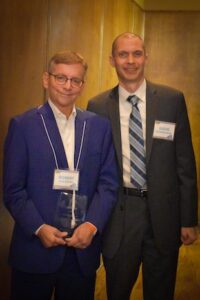
VNA Executive Director Robert DiLeonardi with CCH Executive Director Doug Schenkelberg
VNA Foundation is a generous supporter of the Law Project, providing funding since 2016 to develop and launch StreetLight Chicago. Co-managed with the Young Invincibles, this free mobile app provides up-to-date information on resources for youth experiencing homelessness. Since its launch, the app has been downloaded more than 2,700 times. Today, VNA Foundation continues to provide critical support of CCH’s health care access and education work.
“We’ve never had a better partner than CCH. When I think of the grants we’re most proud to give, I think of the StreetLight grant and our partnership,” said VNA Executive Director Robert DiLeonardi.
JPMorgan Chase Legal Department – Pro-Bono Partner
JPMorgan Chase has provided pro-bono support of the Law Project for more than a decade. Volunteer attorneys host annual “Chase Day of Service” events, targeting youth and families experiencing or at risk of homelessness. During last spring’s event, 15 attorneys helped the Law Project close 61 cases for 32 people at two elementary schools and a family shelter on Chicago’s West Side. They assisted families with birth certificate requests, public benefits, and preschool enrollment.
“We enjoy doing this work. We do it from our hearts,” said Sharlita Davis, a CCH Board member and Chase attorney who coordinates the outreach projects with CCH.
Nasia Smith – Former Youth Futures Client & CCH Scholarship Recipient
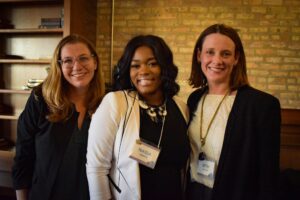
Nasia Smith (center) with CCH Law Project Director Patricia Nix-Hodes and Associate Director Beth Malik
Nasia Smith, a former Youth Futures client, was kicked out of her home when she became pregnant at age 16. Despite coping with homelessness while raising her son, Nasia graduated second in her high school class. In 2014, she became the first CCH college scholarship winner to earn a bachelor’s degree as a single parent. She worked full-time to support her young son while earning a business degree, graduating with honors from the University of Arkansas. Today, Nasia works for a non-profit in Dallas and she and her husband are raising their four sons.
“I am so honored to be here tonight. Because of you, I had hope and my dreams came true,” Nasia said, in accepting her achievement award.
The Law Project is grateful to the signature sponsors of this year’s Justice Circle event: JPMorgan Chase and Baker McKenzie. Other sponsors include United Airlines; Burke, Warren, MacKay & Serritella, P.C.; and Funkhouser Vegosen Liebman & Dunn Ltd.