
What is SNAP?
To qualify for SNAP, a household’s total gross monthly income must be less than 165% of the federal poverty limit. A “household” is anyone living together who regularly purchases and prepares meals together.
Certain people must be considered in the same household for the purposes of SNAP, including:
- Parents and children up to age 22 IF they live together
- Minors under 18 years old living with an adult caretaker
- Spouses who live together must be on the same SNAP account
Note: You may not sell your SNAP benefits to someone else.
SNAP benefits cannot be used to purchase:
- Alcohol
- Tobacco products (such as cigars, cigarettes, and/or e-cigarettes)
- Soap
- Paper products
- Vitamins
- Medicines
- Prepared foods
- Non-food items (except seeds and plants)
Are you eligible?
You may be able to get SNAP benefits in Illinois for you and your family if you:
- Live in Illinois
- Have been a U.S. citizen OR legal permanent resident for 5 years or more.
Some people with special types of visas may qualify for SNAP.
If you are not a U.S. citizen or permanent resident, you may still apply for benefits for your child if they are a U.S. citizen. - Meet the income requirement:
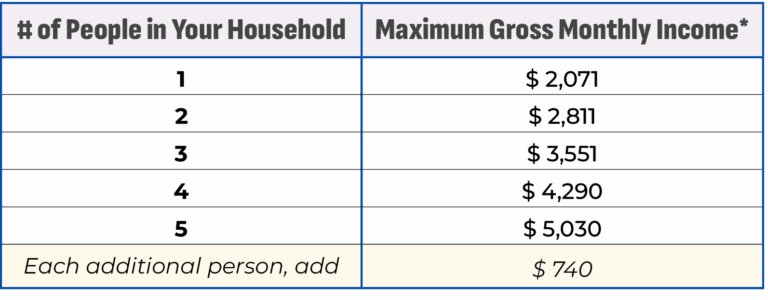
*Gross income is your total monthly income from all sources before any tax deductions. These amounts are only guidelines and do not apply to all households. The maximum income is higher if you are over 60 or disabled.
How to apply for SNAP
You can apply for SNAP benefits one of four ways:
Have the names, social security numbers, birthdates, and income for you and your household members available before starting the application. If you are only applying on behalf of your child who is a U.S. citizen, you do not need to provide your social security number.
After you apply, IDHS may contact you for a follow-up interview to provide income and identity documents or other information.
If you are homeless:
- The application will ask if you are homeless. If you respond “yes,” your application should process faster.
- You can still apply for your own SNAP account if you are doubled-up (couch surfing or sharing the housing of others) as long as:
- You are over 18 years old.
- You are staying temporarily.
- You are responsible for providing your own food and meals.
- You do not need a phone number or mailing address to apply for SNAP.
- You can use the local IDHS office as a mailing address.
TIP: If you do not have a phone or mailing address, you should complete the application in person at the local office or over the phone (if you can access one). Ask if you could pick up your LINK card at the office.
If you are an unaccompanied young person:
- If you are over 18, you can apply for SNAP on your own if you do not live with a parent or guardian.
- If you are under 18, you can apply on your own if you are experiencing homelessness and are not under the care or control of an adult. If you are still on a parent or guardian’s SNAP account, you can ask IDHS to remove you from their account so you can apply independently for your own benefits.
Work Requirements
Beginning February 1, 2026, participants in the SNAP program (sometimes called “Food Stamps” or “LINK”) between the ages of 18 and 64 will be required to work or volunteer a minimum of 80 hours per month or participate in certain training or education programs to continue receiving their SNAP food benefits after April 30, 2026 for current recipients or after the first three month of benefits for new recipients.
To meet the SNAP work requirements a person must:
- Work (paid or unpaid) an average of 20 hours per week; or
- Participate in a SNAP Employment and Training activity such as basic education, vocational training, work experience, community workfare, Earnfare; or
- Do self-initiated community service with a community-based organization for an average of 20 hours per week; or
- Any combination of the above.
Most SNAP recipients need to meet the work requirements, but there are exceptions. The work requirements do NOT apply to anyone who is:
- Unable to work because of physical, mental, and or medical conditions (including temporary conditions and people receiving OR applying for SSI and SSDI)
- Alaskan Native, American Indian, American Urban Indian, or California Indian
- The main caretaker of a disabled person
- Living in a household with a child under 14 years old
- The main caretaker for someone under 6 who lives outside the home
- Enrolled in a school or training program at least half time (Note that there are other SNAP rules for full-time college students)
- Enrolled in a drug or alcohol treatment program (not AA or NA)
- Applied for or is receiving unemployment benefits
- Pregnant
- Chronically homeless
- Working and earning at least $935/month (gross/total income)
People in any of these categories need to provide documentation to IDHS proving that they fit into one of these categories and do not need to meet the SNAP work requirements. If you qualify for one of these exemptions, you can complete this form (bit.ly/snapexemption) by checking which exemption(s) applies to you, signing and dating the form, and submitting it to IDHS. You can either:
- Upload the form to “Manage My Case”
- Fax it to your local IDHS Office, or
- Submit in person to your local IDHS Office.
To find your local IDHS Office, use the IDHS Office Locator.